Showing posts with label Supreme Patriarch. Show all posts

Tuesday, September 29, 2026

Wat Bowonniwet Revisited: Phra Pairee Pinas, the Golden Chedi & Bangkok’s Sacred Heritage - Thailand.

Wat Bowonniwet Vihara is a first-class royal Buddhist monastery and an important centre of the Dhammayut tradition. Its history is closely connected with Prince Mongkut, who became King Rama IV, and the temple has long been associated with royal Buddhist life in Thailand. What makes Wat Bowonniwet especially fascinating is that it is more than a beautiful monument—it remains a living place of Buddhist practice. The quiet atmosphere, saffron-robed monks, intricate architecture and sense of devotion make the experience feel intimate and authentic. For me, visiting Wat Bowonniwet was a chance to pause amid the busy rhythm of Bangkok and experience a quieter side of Thailand—a place where history is not simply displayed, but continues to live through faith, tradition and everyday monastic life.

The present Ubosot dates to the reign of King Rama III in the 19th century. One of its most interesting characteristics is its Thai-Chinese architectural influence. Rather than the highly elaborate roof decorations found at many Bangkok temples, the building has a comparatively restrained appearance, with strong geometric forms and richly decorated stucco details. A particularly unusual feature is the placement of the bai sema, the sacred boundary markers that define the consecrated area of the ordination hall.
Inside the Ubosot are two especially important Buddha images. Phra Buddha Chinnasi is the principal and most famous image. It is a Sukhothai-period bronze Buddha, traditionally dated to around 1357. The temple's own history identifies it as one of Thailand's celebrated Buddha images. Behind it is Phra Buddha Suwannakhet, also known as Luang Pho To. The image was brought from Wat Sa Taphan in Phetchaburi when the temple was established. The arrangement creates a particularly beautiful visual experience: the golden Buddha figures become the spiritual centre of the otherwise relatively calm and elegant interior.

The Ubosot also carries an important connection with Thailand's royal and Buddhist history. Prince Mongkut, the future King Rama IV, became the temple's first abbot in 1836 and spent many years as a monk at Wat Bowonniwet before ascending the throne. Because of this history, Wat Bowonniwet became an important centre of the Dhammayut Buddhist tradition and has remained closely associated with Thailand's royal Buddhist heritage. 

Perhaps the most fascinating feature of the Ubosot is its 19th-century murals by 'Khrua In Khong', one of the most important Thai painters of the period. The murals were created during the time of Prince Mongkut, who later became King Rama IV. 'Khrua In Khong' is famous for introducing Western-influenced perspective and visual techniques into Thai mural painting. Consequently, the paintings at Wat Bowonniwet have a distinctive character: traditional Buddhist themes appear alongside representations influenced by the Western world.

One of the details that caught my eye at Wat Bowonniwet was its beautiful arched entrance, quietly standing within the old temple walls.mWith its graceful curved form and subtle Chinese influence, the archway creates a fascinating transition between the busy streets of Bangkok and the peaceful world of the temple. Walking through it feels almost symbolic—leaving the noise and movement of the city behind and entering a space shaped by centuries of Buddhist devotion, art and history.

The red-painted building near the front entrance of the temple complex, the administrative and monastic buildings around the main sacred precinct. A portrait of Somdet Phra Yannasangwon, the one most recently associated with Wat Bowonniwet was Somdet Phra Yannasangwon (Charoen Suvaddhano), the 19th Supreme Patriarch of Thailand (1989–2013). He served as the temple's sixth abbot from 1961 until 2013 and spent much of his life at Wat Bowonniwet. He is particularly remembered for being the preceptor and spiritual mentor of King Bhumibol Adulyadej (Rama IX) during the King's 1956 monkhood. Wat Bowonniwet remained his principal monastic home until his death in 2013. 

Flanking the Ubosot are two elegant prang-shaped shrines, each sheltering a historic Buddha image. Their graceful arched openings and tiered roofs create a striking frame around the ordination hall, while the distinctive sema stones mounted along the walls mark the sacred boundary of the Buddhist sanctuary. Architecturally, the structures are quite distinctive. They have a raised base with an arched opening, a square shrine body with a curved decorative arch, and a five-turreted prang-like upper section. They were originally constructed as bell towers and were later converted into shrines for Buddha images during the reign of King Rama VI.

One of the most striking features is its gleaming golden chedi, which rises above the temple grounds and creates a magnificent focal point. Inside the temple complex are revered Buddha images, historic structures and beautiful artistic details that reflect centuries of Thai religious and cultural heritage. The temple also preserves a remarkable Sukhothai-era Buddha footprint, adding another layer of history to the visit.
A historic pavilion at Wat Bowonniwet was undergoing renovation during my visit. In front of it is a beautiful open area surrounded by several traditional temple structures, including a distinctive bell tower. The peaceful setting, with its graceful architecture and timeworn details, offers a glimpse into the temple’s rich Buddhist heritage and enduring cultural traditions.
On the upper tier of the Golden Chedi, there are four corner arched niches with spires, each housing a standing Buddha image.
Around the golden chedi stand six magnificent celestial beings, quietly watching over the sacred monument. Shiva and Narayana occupy the eastern side, the celestial musicians Panchasikha and Gandhabha appear on the west, while Brahma and Vissukamma stand to the north. Together, these figures create a remarkable spiritual and artistic circle around Wat Bowonniwet’s gleaming chedi, adding a sense of protection, divine presence and movement to the otherwise serene architecture. One fascinating detail is that the Chedi also has four animal figures above its four entrances—a bird to the north, elephant to the east, lion to the south, and horse to the west. These are separate from the six celestial beings and have their own symbolism.

Surrounding the magnificent Golden Chedi are numerous sacred images and beautifully crafted figures, each adding its own layer of meaning to the temple's spiritual and artistic landscape. Standing gracefully around the chedi are Buddha images, celestial beings and mythical figures, carefully positioned according to the traditional layout of the sacred monument.
The Phra Pairee Pinas image is housed in an elaborate niche on the upper terrace of the Great Golden Chedi, facing south toward the main chedi. So if you were walking around the Golden Chedi and noticed a Buddha image enshrined in a beautifully decorated niche, that is likely Phra Pairee Pinas.
Phra Pairee Pinas, a revered Buddha image whose name carries the meaning “the vanquishing of enemies.” Enshrined within an ornate niche facing the golden chedi, the image has an intriguing history closely connected with Prince Mongkut, the monk who later became King Rama IV.

What makes Phra Pairee Pinas especially remarkable is its unusual artistic character. Its form recalls the ancient Dhyani Buddhas of Central Java, particularly the Buddhist sculptures of Candi Kalasan, yet it was presented and adapted within the artistic world of 19th-century Siam.

The image is also surrounded by a fascinating story. It was presented to Prince Mongkut during his years as a monk at Wat Bowonniwet, at a time when he faced opposition from influential figures. When his adversaries subsequently fell from favour, the Buddha image became associated with the overcoming of enemies and received the auspicious name Phra Pairee Pinas.

Standing before this small but historically rich shrine, one encounters far more than a Buddha image. It represents a remarkable meeting of Thai and Javanese Buddhist art, royal history, monastic tradition and centuries-old beliefs in the protective power of sacred images.

Another fascinating aspect of Wat Bowonniwet is its beautiful Chinese artistic influence. Around the base of the Golden Chedi are numerous Chinese stone figures and decorative objects, creating a striking contrast with the traditional Buddhist architecture of the temple. The Chinese influence becomes even more apparent in the area beyond the chedi, where elegant Thai-Chinese halls, guardian lions and richly decorated architectural details create a distinctive atmosphere. These elements reflect the close cultural and artistic connections between Siam and China during the early Rattanakosin period. The statues are more than decorative ornaments. They form part of a fascinating visual dialogue between Thai Buddhism and Chinese artistic traditions. Walking through the temple grounds, one encounters Buddha images, celestial figures, Chinese guardians and mythical creatures side by side, making Wat Bowonniwet a remarkable example of how different cultural traditions were brought together within a single sacred complex.

Wat Bowonniwet—Phra Tamnak Phet, or the Royal Diamond Residence. Tucked within the quieter monastic and residential quarter, this elegant historic building has a very different character from the traditional Buddhist structures surrounding the chedi. Built during the reign of King Rama VI and completed in the early 20th century, Phra Tamnak Phet was created as an important reception and assembly hall for Somdet Phra Maha Samana Chao Krom Phraya Vajiranyanavarorasa, one of the most influential Buddhist leaders associated with Wat Bowonniwet.

Phra Tamnak Phet also carries a deeper historical significance. The site was once associated with a printing house established during the time of Prince Mongkut, later King Rama IV, when Wat Bowonniwet was becoming an important centre of Buddhist learning and scholarship.

Today, the building stands as a quiet reminder of the temple's long history—not only as a place of worship, but also as a centre of Buddhist education, royal patronage, scholarship and monastic administration. 

 .

See info for amulet from Wat Bowonnivet at: 

👉 http://thaiamulets-dhammapath.blogspot.com/search/label/Wat%20Bowonnivet?m=0

.

Or other amulets in mainpage Blog at:  

👉 http://www.thaiamulets-dhammapath.blogspot.com/?m=0

Tuesday, October 15, 2024

Visiting Wat Ratchabophit (BE2567) ~ Abbot Is Somdet Phra Ariyavongsagatanana ~ The Current Supreme Patriarch Of Thailand.

Wat Ratchabophit is one of the amazingly decorated temples in Bangkok, not far from Wat Pho and Wat Phra Kaew ~ The Temple of the Emerald Buddha. It is yet another fine example of the wide range of color and architectural styles reflected in these beautiful structures. The colorful tiled rooftops, golden spires, and vaulting structures of Wat Ratchabophit are reminiscent of both traditional Thai architecture and gilded Italian architectural influences. Wat Ratchabophit is easily included in a central Bangkok tour and would be worth a visit.
The main Ubosot of Wat Ratchabophit. The back side is located the Golden Chedi (43 meter) and another wiharn with a unique layout. The Ubosot and Wiharn joined by a circular courtyard, at the center of which stands a gilded Golden Chedi covered with orange-coloured tiles and on top of the chedi, there is a golden ball. There is a sacred Relic of Phra Buddha inside and the chedi was built in Sri Lankan style. The Ubosot ordination hall has 10 door panels and 28 window panels each decorated with gilded black lacquer on the inside.

Photo taken in front the Ubosot of Wat Ratchabophit.

During my visited, a group of school children attended dhamma study inside the Ubosot. The sermon talk given by a monk of Wat Ratchabophit. A very good atmosphere.
The Phra Phuttha Angkhirot, the principal Buddha image of the ubosot at Wat Ratchabophit, was made of gold in the reign of King Rama V. The gold weighing 2.7kg used in moulding the statue had been melted from jewellery worn by King Rama V when he was a young prince. The statue is in the meditation posture and wearing a pleated saffron robe. Its lap is 1.5m wide. It was named after one of the previous Lord Buddhas, meaning there's an aura around the body. The base was made of marble imported from Italy. Inside the base are enshrines the Royal ashes of Thai monarchs of King Rama V, King Rama VII and his queen, and King Rama IX. 

The inside interior of the temple Ubosot, is inspired by gilded Italian architecture that King Rama V saw on a visit to Europe. The entrance doors are 3m high and are decorated with inlaid mother-of-pearl, which represents various medals and decorations.
The front of Ubosot, center the Golden Chedi and back side another Wiharn in one layout combination.
The photo taken of the beautiful and stunning view.
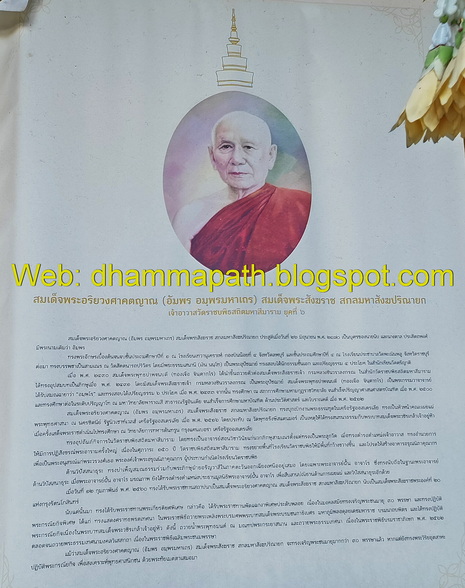
Photo taken with portrait of Supreme Patriarch - His Holiness Somdet Phra Ariyavangsagatayana IX.
His Holiness Somdet Phra Ariyavangsagatayana IX (Thai: สมเด็จพระอริยวงศาคตญาณ) is the current Supreme Patriarch of Thailand. His Holiness Somdej Phra Ariyawongsagatayan (Amporn Amphon Maha Thera), born on June 26, 1927, the son of Mr. Nab and Mrs. Tan Prasatthaphong, his original name was Amporn. He studied the basic alphabet until the end of first grade at Thewanukroh School. 4th Wing of Lopburi Province and Grade 4 at Wat Phanoen Phlu Local School Ratchaburi Province. Later, he was ordained as a novice at Wat Sattanath Pariwat, with Phra Thammasenani (Ngern Nontho) as the preceptor. He passed the examination for a first-class Dhamma scholar and four sentences of precepts in the Wat Triyat School.

In 1947, His Holiness Somdet Phra Phutthapapotchanabodi (Thongchua Chinthakaro) was presented to the Supreme Patriarch. Krom Luang Chinwaralongkorn In the office of Wat Ratchabophit Sathitmahasimaram. He was ordained as a monk in 1948 with His Holiness the Supreme Patriarch. Krom Luang Chinwaralongkorn Be a preceptor Somdej Phra Phutthapapotchanabodi (Thongchua Chinthakaro) is a monk. Received the nickname "Amparo" and passed the 6-sentence Dhamma examination in 1950. After that, he studied at the Mahamakut Buddhist College of Education until graduating with a Bachelor of Theology degree in 1957 and continued his studies at the master's degree level at Varanasi University, republic of india until graduating with a master's degree History and archaeology in 1969. His Holiness Somdet Phra Ariyawongsagatayan (Amporn Ampromahathera), Somdet Phra Sangharaja. Sakon Maha Sanghaparinayok He pioneered missionary work in the Commonwealth of Australia. He was the head of the Buddhist mission in Sydney, New South Wales. Commonwealth of Australia in 1973, staying at Wat Buddharangsi Stanmore. As a result, he was given the opportunity to discuss Dhamma with His Majesty King Vajiralongkorn. When His Majesty went to study at Dunthrun Military College, Canberra, Commonwealth of Australia.

He supported the duty of Wat Ratchabophit Sathit Maha Simaram. He was a teacher teaching discipline to monks and novices since he was a monk. When he held the position of abbot, he directed a major renovation of the monastery. On the occasion of Suphawara 150 years, Wat Ratchabophit Sathit Maha Simaram, he expanded the area of ​​Wat Ratchabophit School to have a larger area and please allow the construction of the Arun Nipa Kunakorn Building as a memorial to Her Royal Highness Her Royal Highness Princess Arun Nipagunakorn, who gave launch to Wat Ratchabophit School Vipassana business. He always practiced asceticism together with the Aranvasi monks in the northeastern region. Especially Phra Achan Fan Ajaro, who is respected as a teacher Vipassana Tudong Forest Tammayut (Wat Pha Udom Somporn, Sakon Nakorn – Guru Master of the Thai Forest tradition of the Lineage of Luang Pu Mun Bhuridatto). When Phra Achan Fan Ajaro passed away, he still held the position of president of the Phra Ajarn Fan Ajaro Foundation to continue the mission of propagation and introspection as well.

On February 12, 2017, His Majesty was granted the royal title of Somdej Phra Ariyawongsakatayanana. Somdet Phra Sangharaja Sakon Maha Sanghaparinayok He is the 20th Supreme Patriarch of Rattanakosin. Since then, His Majesty has been bestowed with special honors, that is, he has been given a special ivory fan decorated with precious stones. On the auspicious occasion of His Majesty's 50th birthday and performing His special duties included giving a sermon. In the Royal Cremation Ceremony of His Majesty King Bhumibol Adulyadej His Majesty King Bhumibol Adulyadej the Great and has performed Royal duties on the occasion of His Majesty King Vajiralongkorn are as follows: Offering holy water to the Buddha at the Phra Krayasanan Monastery and offered sermons. On the occasion of the Royal Coronation Ceremony 2019, as well as delivering the auspicious sermon On the occasion of the royal birthday celebration ceremony. Although Somdet Phra Ariyawongsagatayan (Amporn Ampra Maha Thera), the Supreme Patriarch Sakon Maha Sanghaparinayok His Holiness will be more than 90 years old, but he will still be diligent and perform royal duties to help Buddhists always with kindness.

More surrounding photos of the outside buildings are decorated with hand-painted glazed tiles similar to Thai benjarong enamels, while the doors and window frames are elaborately decorated with gold and mirrors.
The temple hall building, Drum, Bell Tower and Monument Prang Chedi.
The doorway to Golden Chedi, with 2 Elephants guardian.
The beauty of Ornamental tree and plant.
The door guardian and paintings.
Photo taken with the Golden Chedi.
Front Ubosot, Golden Chedi and back Wiharn building.
The Chedi of Mausoleum of Savang Vadhana located on the west end of the temple grounds. The Royal Cemetery, with numerous monuments to major and minor members of the Royal Family, most notably those in the immediate family of King Chulalongkorn. One of the memorials, the Rangsi Vadhana Memorial, contains the ashes of Mahidol Adulyadej, the father of King Ananda Mahidol (Rama VIII) and King Bhumibol Adulyadej (Rama IX), Srinagarindra (his wife) and Galyani Vadhana (his daughter).
The statue of a seated King Rama V, King Chulalongkorn of Thailand (1853-1910) in the grounds of Wat Ratchabophit, Bangkok.
The Kuti building, Bell Tower and Wiharn building.
The door guardian, side door of Wat Ratchabophit.
The side view of temple Wat Ratchabophit.

.
See more Wat Ratchabophit amulets at:

👉https://thaiamulets-dhammapath.blogspot.com/search/label/Wat%20Ratchabophit

.

See more of other Thai amulets at:

👉http://thaiamulets-dhammapath.blogspot.com/?m=0