Showing posts with label 林府姑娘. Show all posts

Sunday, May 17, 2026

Revisited Famous Chinese Temple 同声善堂 (Tóng Shēng Shàn Táng) & Thong Sia Siang Thung Foundation - Song DaFeng (宋大峰祖師) Chinese Temple - HatYai City - Songkhla - Thailand.

Visiting Thong Sia Siang Thung Temple brings a peaceful and meaningful feeling. The calm atmosphere, the scent of incense, and the beautiful Chinese architecture create a sense of respect and spiritual connection. Giving a donation at the temple feels especially rewarding because it helps support charity work and people in need. It is not only an act of worship, but also a way to share kindness, compassion, and blessings with the community.

Thong Sia Siang Thung Foundation Temple is one of the most respected Chinese charitable temples in Hat Yai, Thailand. Established by the local Chinese community, the temple serves both as a place of worship and a center for charity and community service. Deeply rooted in Chinese culture and traditions, the foundation reflects the strong heritage of the Thai-Chinese community in southern Thailand. The temple is well known for its beautiful Chinese architecture, colorful decorations, and sacred shrines dedicated to various Chinese deities such as Song DaFeng (宋大峰祖師), Tua Pek Gong (福德伯公) and Mae Chao Lim Ko Niao (林府姑娘). Besides religious activities, the foundation is also involved in humanitarian work, including rescue services, funeral assistance, and support for people in need. Thong Sia Sieng Thung Foundation plays an important role during major Chinese festivals, especially the Vegetarian Festival, when thousands of devotees gather for ceremonies, prayers, and cultural celebrations. Today, the temple remains a symbol of faith, compassion, unity, and traditional Chinese values in Hat Yai.

The PaiFang (牌坊) of Thong Sia Siang Thung Temple (同聲善堂) is a ceremonial archway that marks the sacred entrance to the temple dedicated to Song Da Feng Zu Shi (宋大峰祖師), a respected figure known for promoting kindness, compassion, and helping others. The PaiFang symbolizes blessings, protection, and the temple’s charitable spirit. Next to the PaiFang is the donation building of the Thong Sia Siang Thung Foundation, where devotees and visitors can contribute donations to support charity work and help people in need. It reflects the temple’s mission of compassion, generosity, and community care.

This is the donation area located inside the foundation office building, where devotees and visitors can make charitable contributions.
The main pavilion of Thong Sia Siang Thung Temple (同声善堂), featuring traditional Chinese architectural design and religious ornamentation.

Song DaFeng (宋大峰祖師) a Buddhist monk of the Song Dynasty, once engaged in charities provided help collected corpses for free cremated and funeral, medical care, education, bridge building and other charities in Chaoyang of Guangdong Province. Song DaFeng (宋大峰祖師) was born in Zhejiang Province in year 1039 to a Wenzhou wealthy family, by surname Lin (林灵噩) from Fujian. When childhood, he studying Buddhist scriptures and got imperial Scholars awards and engaged magistrate duties. Until the age of 54, the political corruption was disappointed, he was quit and ordained as monk and promoted Buddhism everywhere. At the age of 81, heavy rains caused river flooding in Chaoyang of Guangdong Province, triggering plagues and other disasters and resulting in many unclaimed bodies. Song DaFeng (宋大峰祖師) collects corpses for cremation, sets up clinics, supplies food to those in need, and educates his disciples on the virtues of helping others. At year 1127, Song DaFeng was passed away at 88 years old. Because of the Song DaFeng (宋大峰祖師) merits, everyone is grateful. Therefore, after the death, it was widely enshrined by the Chaoshan people. There were many temples in Chaoshan, Hong Kong and other places in Southeast Asia also worshipped the Song DaFeng (宋大峰祖師).

Praying to Song Da Feng Zu Shi (宋大峰祖師) brings a feeling of peace, comfort, and spiritual strength. His teachings of compassion and helping others inspire devotees to practice kindness and generosity. Standing before his altar, many people feel calm, protected, and grateful while praying for blessings, good health, and guidance in life.
Photo taken with 福德正神 or 福德伯公, the revered deity of prosperity, protection and the landlord.
The altar is dedicated to 林府姑娘, Mae Chao Lim Ko Niao of Pattani origin. Positioned at the front is a Guman body dating from BE2537, where worshippers come to pray and pay their respects.
Displayed within the Thong Sia Siang Thung Foundation are portraits of its founder, Yongkiat Paiboon, established in BE2499, together with the committee members of the foundation.
Inside the pavilion of the Thong Sia Siang Thung Temple, numerous red lanterns hang beautifully from the ceiling, creating a traditional and festive atmosphere.
The whole area of Thong Sia Siang Thung Foundation with the building for the rescue division. Thong Sia Siang Thung Foundation is well known for its community welfare work and charitable services. Its activities include a dedicated rescue division that provides volunteer emergency support and disaster relief assistance. These services typically cover ambulance and basic emergency transport, first aid at incident scenes, disaster response for floods, fires, and accidents, as well as funeral support and coffin donations. In addition, the foundation may also operate free clinics and other forms of welfare aid for those in need.
The spacious hall at Thong Sia Siang Thung Temple, featuring a large awning, serves as a venue for various religious, cultural, and community events. Adjacent to the hall is the 三寶佛公 Pavilion, which enshrines statues of the Buddha, Bodhisattva Guanyin, and the Laughing Buddha.
The Dragon pillar in Thong Sia Siang Thung temple. The dragon is a symbol of power, protection, and good fortune, so it is often carved or painted on on Pillar for symbolize protection of the sacred space with strength, prosperity, and spiritual guardianship.
Within the Thong Sia Siang Thung Temple complex, there is a shrine dedicated to Brahma (Phra Phrom), where devotees offer prayers for blessings, protection, and good fortune.
Another shrine dedicated to Phra Pikanet (Ganesha), where devotees offer prayers for blessings, wisdom, protection, and good fortune.
 . 

See more amulets Song DaFeng (宋大峰祖師) by 同声善堂 - Tóng Shēng Shàn Táng at:

👉 https://thaiamulets-dhammapath.blogspot.com/search/label/%E5%90%8C%E5%A3%B0%E5%96%84%E5%A0%82%20-%20T%C3%B3ng%20Sh%C4%93ng%20Sh%C3%A0n%20T%C3%A1ng?m=0

.

See more Thai amulets at:

👉 http://www.thaiamulets-dhammapath.blogspot.com/?m=0

Sunday, July 14, 2024

Revisited BE2567 ~ Graveyard Chao Mae Lim Ko Niao (林府姑娘) Of Pattani - Thailand (Part 2/2).

The peaceful and spacious place of graveyard Chao Mae Lim Ko Niao with a very beautiful garden surrounding. It is convenient to pay homage because you can park on the roadside. I am very glad to have the opportunity to come and pay homage at the graveyard good for remembering history and legend.
Located at Ban Krue Se, Tambon Tanyong Lulo, Amphoe Mueang on highway no.42 (Pattani-Narathiwat route).
In the past, the graveyard of Chao Mae Lim Ko Niao was located at the old Pattani Bay area where the place to park trading boats. But over time and sea water erosion occurred at the old Pattani Bay area. During the reign of King Rama V, it was ordered to be preserved. Therefore, a ceremony was held to invite the mausoleum of Goddess Chao Mae Lim Ko Niao relocated to the city of Krue Se and Pattani people built the Shrine to commemorate her and carved and a statue of Goddess Chao Mae Lim Ko Niao (from the cashew nut tree where she hung herself) which is located behind Krue Se Mosque. After some time more people moved to new Pattani city. During this period statue of Goddess Chao Mae Lim Ko Niao was brought to the 靈慈宮 Leng Ju Khieng Shrine in Pattani where the statue Chao Mae Lim Ko Niao venerated now.

Photo taken at front of Graveyard Chao Mae Lim Ko Niao.
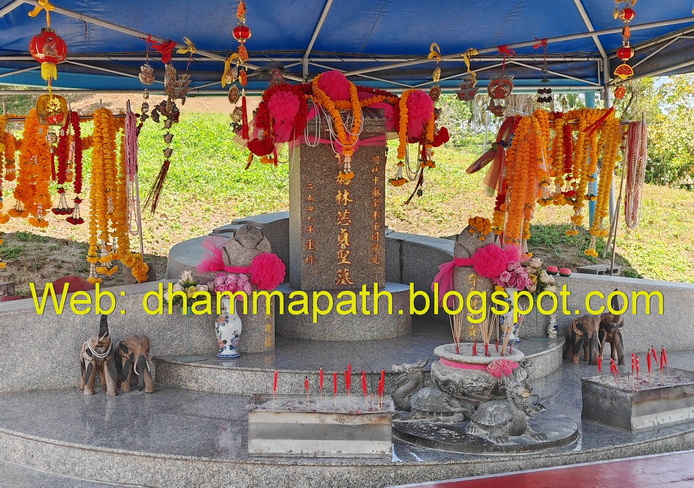
The graveyard and new plant cashew tree with clothes offering by worshipper. The old cashew tree carved to statue of Chao Mae Lim Ko Niao.
Shrine of  Tudi Gong 土地公 (God of the Land).
Here the 林府姑娘聖墳.

The few of shady resting spaces (required as the heat of the day increases) for people visit here.
The giant water tank with Dragon and Phoenix (same as at the Shrine), built in BE2530.
Ancient Krue Se Mosque or Sultan Muzaffar Shah Mosque, is a ancient mosque in Pattani province, Thailand. Its construction may have begun in the 16th century. The surviving structure is described as having a mixture of Middle Eastern or European architectural styles. Some believe that the mosque was built by the Chinese pirate Lim Toh Khiam, who established a base in Patani in 1578. According to local lore, Lim Toh Khiam married the daughter of the Sultan of Patani, claimed to be Raja Hijau and converted to Islam. Next to the mosque is a garden as well as the graveyard of Chao Mae Lim Ko Niao, the sister of Lim Toh Khiam, who in this tale placed a curse so the dome of the mosque could not be completed. Lightning was said to have struck the mosque every time an attempt was made to complete the building. According to the local lore, Lim Ko Niao went looking for Lim Toh Khiam when their mother became ill, she swearing not to return until she had brought him back. She found Lim Toh Khiam in Patani, where he had married the daughter of the Sultan, converted to Islam and was building a mosque for the Queen. However, he refused to return and fought her instead, and she then committed suicide by hanging from a cashew tree. Before she died, she was said to have cursed the mosque her brother was building, believed to be the Krue Se Mosque, so that it could never be completed – every time someone tried to finish the building, a lightning would strike the building.
The information banner for this place.
  .

See amulets from Shrine 林府姑娘 Chao Mae Lim Ko Niao at:

http://thaiamulets-dhammapath.blogspot.com/search/label/Chao%20Mae%20Lim%20Ko%20Niao 

.

See more other Thai amulets at: 

http://www.thaiamulets-dhammapath.blogspot.com/?m=0 

Tuesday, July 9, 2024

Revisited BE2567 ~ Chao Mae Lim Ko Niao Chinese Shrine (林府姑娘) Of Pattani - Thailand (Part 1/2).

The 靈慈聖宮 Chao Mae Lim Ko Niao Shrine (林府姑娘) in Pattani ~ Thailand holds significant cultural and religious importance in the region. Situated in the heart of Pattani City, this revered shrine is dedicated to Chao Mae Lim Ko Niao, a legendary figure revered by locals for her benevolence and miraculous powers. The shrine serves as a focal point for worship, pilgrimage, and community gatherings, attracting devotees and visitors from across Thailand and beyond.
Photo taken at front side Shrine Chao Mae Lim Ko Niao and the temple name 靈慈聖宮.
Photo taken with the big incense pot of Dragon Head Turtle for the base.
The origin name of the Shrine 靈慈宮 Leng Ju Khieng.
The main altar with venerated sacred 清水祖师 wooden sculpture.
The information counter for the shrine.
The counter for items for praying and offering.
The altar of Chao Mae Lim Ko Niao (Lim Gu Niang) 林府姑娘.
The side courtyard with photo of the Legends of Eight Immortals.

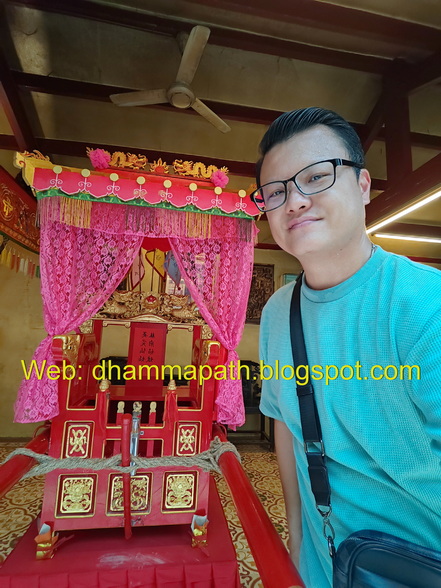
The sacred ornate sedan chair use for devotees ferry their gods during the festival event. The sacred Chao Mae Lim Ko Niao Festival (งานสมโภชเจ้าแม่ลิ้มกอเหนี่ยว) is held every year in Pattani (starting on the 14th day of the Chinese New Year). The following day on the 15th, the wooden image of Chao Mae Lim Ko Niao and other statues of various deities worshipped at this temple as well as others from the neighbourhood temples are carried by the locals in a grand procession. The images are carried across the Pattani River for bathing in the water and later in the day, the carriers also walked over fire.
The side altar and back side altar with venerated 福德正神, Mercy Guan Yin and other Chinese religious figures.
The sacred LingQi 令旗 of Shrine Chao Mae Lim Ko Niao.
On the side there is also a goddess museum and also places to hold festival event.
The new built Pillar and colorfully decorated traditional Chinese pagoda in the courtyard.
The giant water tank with Dragon and Phoenix, built in BE2530.
 .

See amulets from Shrine 林府姑娘 Chao Mae Lim Ko Niao at:

http://thaiamulets-dhammapath.blogspot.com/search/label/Chao%20Mae%20Lim%20Ko%20Niao 

.

See more other Thai amulets at:

http://www.thaiamulets-dhammapath.blogspot.com/?m=0