Showing posts with label Reclining Buddha. Show all posts

Saturday, November 21, 2020

Visiting Largest Reclining Buddha Statue In Kelantan - Wat Phothivihan & The Late PT Hua.

One of the Largest Reclining Buddha by Wat Phothivihan. The temple houses a 40 metre statue of a sleeping Buddha, which is considered as the largest and longest in the state since its construction in 1975. Past abbot Phor Than Hua was supervised the project built this Recining Buddha.
Vast area and have plenty of car parking just in front of the Big Reclining Buddha statue.
The temple gate of Wat Phothivihan and beside is the siam restaurant stall.
Photo taken with Longest Reclining Buddha statue in Malaysia with 40 meter long and completed in year 1979.
The mural of Phra Hanuman and his lover, Suvannamaccha. She is a daughter of Tosakanth appearing in the Thai and other Southeast Asian versions of Ramayana. She is a mermaid princess who tries to spoil Hanuman's plans to build a bridge to Lanka but falls in love with him instead.
A lot of Phra Buddha statues venerated surrounding the Reclining Buddha statue. Underneath and to the rear of the Reclining Buddha is a columbarium (a vault with recesses to deposit urns containing the ashes of the departed).
Here the entrance for the columbarium (a vault with recesses to deposit urns containing the ashes of the departed).
The big of Dhammacakra located in front of the Reclining Buddha statue.
The big Shrine of Phra Phrom at Wat Phothivihan.
The Chinese shrine of Thousand Hand Boddhisattvas Guan Yin and Lion at front shrine as guardian. Have many mural image inside the shrine.
Shrine of Lersi.
The old ubosot building of Wat Phothivihan.
The unique Chedi and Kuti room for monks resided.
The small pond for tortoises.
The prayer hall of Wat Phothivihan. 
Inside the hall, the main altar. 
During my visited, was death anniversary of Phor Than Hua. He was passed away at april 2013.
The photo of Phor Than Hua, past abbot of Wat Phothivihan, Kampong Jambu, Tumpat, Kelantan. He has been 45 years as Chief Monk of Wat Phothivihan, born on June 09,1933. He was accepted by Phra Kru Ariyasangworn or Phor Than Lek as a temple boy at Wat Ariyakiri. At the age of 20, the minimum age for monkhood, he ordained as monk at the Tendong Temple ~ Wat Chinpradittharam, near the town of Pasir Mas, under in charge of Phor Than Long. At this temple he learnt the theory and practical of meditation under the personal guidance of Phor Than Long himself. Soon after, the Head of the Thai Sangha or the Buddhist Order in Bangkok despatched a letter to the Head of the Thai Sangha in Kelantan who is residing in Wat Uttamaram in Repek near Pasir Mas appointing Than Hua as the Abbot of Wat Phothivihan. As a first step he initiated immediate repairs to existing buildings, built a small rest house, had a well dug to ensure adequate water supply and planted a 'Tanjong' tree in front of the temple. He also built the statue of the Reclining Buddha. In 1984, Phor Than Hua received the rank of Phra Khru awarded by His Majesty, the King of Thailand for his services rendered to Buddhism.
Another altar for Buddha and mural of Bodhi tree at back.
The building accommodation for monks and visitors of Wat Phothivihan.
 .
See more Thai amulets for rent at:

Monday, April 19, 2010

Wat Pho ~ Wat Phra ChetuPhon Vimolmangklararm Rajwara Mahaviharn In Bangkok Thailand.

Wat Pho, the official name being Wat Phra Chetuphon Vimolmangklararm Rajwara Mahaviharn , is a first grade royal monastery, regarded as the most important one during the reign of King Rama I of the Chakri Dynasty. The importance of this is due to the King having managed the restoration of Wat Phodharam, an old monastery from the Ayutthaya period, and had it re-established as a royal monastery located near the Grand Palace.
This is possibly the most interesting temple in Thailand as it combines history, medical science and is a center for meditaion and traditional massage training. Traditionally, temples were the schools as there was no formal education system, with monks providing basic lesson in both spiritual and secular subjects. King Rama III turned Wat Pho into a major centre for learning in botany, geography and history.
The Vihara of the Reclining Buddha or Phra Buddhasaiyas (Viharn Phranorn), the building is constructed for containing the important Buddha image, the Reclining Buddha. King Rama III told his nobleman, Krom Muen Pumintarapakdi (Prince Laddawan), the head of department of the Ten Crafts as a construction team leader. After having moulded the image of the Reclining Buddha, the team continued with the hall.The image was made of stuccoed bricks gilded with gold leaves. This statue is 46 metres long, with the dimensions at the face of 15 metres high and at each foot of 3 metres high and 5 metres long.
The serene face of the Reclining Buddha.
The giant Reclining Buddha at Wat Pho. On the inner wall of this vihara, you will see mural paintings of three topics:
“Mahawong” (Historical annals of Ceylon) up the windows;
“13 Savida Atadagga Disciples (Priestess)”,
“10 Upasaka Atadagga Disciples” and
“10 Upasika Atadagga Disciples” between each window.
The feet and the eyes are engraved with mother-of-pearl decoration, and the feet also show the 108 auspicious characteristics of the true Buddha.
The soles of the statue's feet are inlaid with mother-of-pearl showing the 108 auspicious signs of the Buddha. This is the largest and most beautiful piece of fine arts of the Buddha image in a reclining position found in Thailand.
The mother of pearl inlay at the feet of the image is of Thai-Chinese style, as indicated by 108 auspicious signs portraying natural scenes of both Indian and Chinese influences.
Back of the Buddha's head and "pillow".
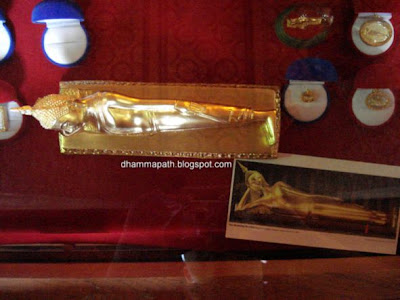
Some Reclining Buddha amulets is for rent at the amulet counter of Wat Pho. The Reclining Buddha image amulet I chowed at Wat Pho during my visit in year 2008.
The principal Buddha image venerated inside the Ubosot is “Phra Buddha Deva Patimakorn” in a gesture of seated Buddha on a three tiered pedestal called Phra Pang Samarthi (Lord Buddha in the posture of concentration), and some ashes of King Rama I are kept under the pedestal.
Phra Maha Stupa or Phra Prang Chedi, there are 4 Chedis at the corners of outer-side of the chapel yard. This kind of pagoda is specially termed “Phra Agghiya chedi”.
Each is tiled with marble, with 4 Khmer-style statues, tin gilded with gold leaves and decorated with glass inlay, of the so-called “Catulokapala” – the Guardian Divinities of the Four Cardinal Points- on its 4 corners.

The stupa on the northeastern corner is called “Phra Buddha Manggala Kayabandhana Mahastupa”,
the southeastern “Phra Buddha Dhammacak Pavattanapaduka Maha Stupa”,
the southwestern “Phra Buddha Vinaiyapitaka Sucigkara Maha Stupa”,
the north-western one “ Phra Buddha Abhidhamma Dharavasi Parikkhara Maha Stupa”.
Wat Pho has 4 big chedis which were built on separate occasions to commemorate the first three kings of the Chakri Dynasty (two chedis for King Rama III). The bell tower of Wat Pho, next to the Ubosot.
The Western style statues at the one of the entrance in the temple compound.
This Standing Buddha in the East Vihara is a 10 metres high bronze Buddha image, “ Phra Buddha Lokanart Sartsadajarn ” which was brought from Wat Phra Sri Sanphet in Ayutthaya.